
What is search engine optimization: Your Quick Start Guide
- Neville Wiles

- 16 hours ago
- 16 min read
So, you’ve heard the term ‘SEO’ thrown around, but what does it actually mean for your business? At its heart, search engine optimisation (SEO) is all about fine-tuning your website so it shows up higher in search results on platforms like Google.
Think of it this way: good SEO makes your website a magnet for people who are already looking for exactly what you offer. It’s not about casting a wide, expensive net; it’s about being the best, most relevant answer when a potential customer asks a question.
What Is Search Engine Optimisation, Really?

Let's ditch the confusing jargon for a moment. Imagine your website is a brand-new book you’ve just placed in a massive, sprawling library. Google is the super-smart librarian in charge of it all. Your goal is to make it dead simple for that librarian to understand your book, trust its quality, and confidently recommend it to every single person who walks in looking for the information inside.
SEO is how you organise your book for that librarian. It’s about giving it a clear title and a logical table of contents (your site structure). It’s making sure the content is genuinely helpful and easy to read. And just as importantly, it’s about getting glowing reviews (what we call backlinks) from other trusted books, signalling to the librarian that your book is a credible authority on the topic.
Why It Matters for Kiwi Businesses
For a small or medium-sized business in New Zealand, getting this right is a game-changer. When someone in Auckland punches "emergency plumber near me" into their phone, or a tourist in Queenstown searches for "best local tour guides," you need Google to point them straight to your website—not your competitor's.
The sheer scale of Google’s influence here makes it impossible to ignore. The search engine holds over 91% of the search market share in New Zealand. With the vast majority of Kiwis turning to Google to find businesses and make buying decisions, you can't afford to be invisible. You can dive deeper into the data on NZ search trends to see just how much this dominance shapes local commerce.
In essence, SEO isn’t about trying to trick Google’s algorithm. It’s about working with it to give people the best possible answers. When you get that partnership right, you attract customers who are already halfway to making a purchase.
To make sense of it all, SEO is generally broken down into three core areas. Getting your head around these pillars is the first step to building a solid digital strategy that actually works.
To get started, here's a quick rundown of the three main components of SEO that we'll explore in this guide.
The Three Core Pillars of SEO Explained
SEO Pillar | What It Means | Simple Analogy |
|---|---|---|
Technical SEO | Improving your website's backend infrastructure. | Ensuring your library book has a sturdy binding and numbered pages so the librarian can read it easily. |
On-Page SEO | Optimising the content on your website's pages. | Writing a clear title, chapters, and compelling content that perfectly answers the reader's questions. |
Off-Page SEO | Building your website's authority and reputation online. | Getting positive reviews and recommendations from other well-respected books and authors. |
Each of these pillars plays a crucial role, and they all work together to build a strong, visible online presence for your business. Let's dig into each one.
Why SEO Is a Game Changer for Kiwi Businesses
So, we’ve covered what SEO is, but let's get into what really matters: how it can actually help your business. This isn't just another box-ticking marketing exercise. For small and medium businesses all over New Zealand, a smart SEO strategy is a powerful engine for real, sustainable growth.
Think of it this way. A radio ad or a billboard is basically an interruption. You're hoping to grab someone's attention for a fleeting moment while they're busy doing something else. SEO is the complete opposite. It puts you directly in front of motivated customers at the exact moment they’re looking for what you offer.
Meeting Customers Exactly When They Need You
That’s the secret sauce of SEO. You stop chasing customers and instead, you make it easy for them to find you. The people who land on your site aren't just random visitors; they're people with a genuine, immediate problem that you can solve.
A plumber in Christchurch, for instance, doesn't need to reach every single person in the city. They just need to be the first name that pops up when a panicked homeowner searches for "emergency leak repair Christchurch" at 2 AM. In the same way, a Wellington shop selling eco-friendly products wants to be the top result for "sustainable gifts Wellington." SEO is what makes that connection happen.
At its heart, SEO is all about attracting high-intent traffic. These aren't people just window shopping. They are actively searching for answers, products, or services, which makes them far more likely to become paying customers.
This targeted approach means the leads you get are much higher quality, and your marketing budget goes a lot further. You’re not just shouting into the void and hoping for the best; you're investing in being visible to people who are already ready to buy. This is one of the key differences we dig into in our guide on digital marketing strategies for small businesses.
Building a Digital Asset That Lasts
A solid ranking on Google does more than just bring in leads—it builds genuine trust and credibility. When your business consistently shows up at the top of search results, customers start to see you as an authority, a reliable expert in your field. That kind of reputation is priceless.
And unlike paid ads, which disappear the second you stop paying for them, the benefits of good SEO grow over time. Every bit of optimised content, every quality link you earn, adds to what you’ve already built, making your digital foundation stronger and stronger.
You’re essentially creating a business asset that works for you around the clock, bringing in leads and sales long after the initial work is done. Here’s a quick look at that long-term value:
Boosted Brand Visibility: Showing up again and again in search results keeps your brand front and centre in people's minds.
Greater Credibility: People naturally trust the organic search results more than the ads. A top ranking feels like an endorsement from Google itself.
Sustainable Lead Flow: Once you've earned your rankings, they can deliver a steady stream of good leads without you paying for every single click.
A Better Website Experience: Much of the work involved in SEO—like improving site speed and creating helpful content—makes your website better for every single person who visits.
At the end of the day, putting effort into SEO is about building a more resilient, more profitable business. It's a long game, but one that delivers compounding returns, cementing your place in the market and connecting you with the Kiwi customers who are looking for you right now.
The Three Main Types of SEO You Need to Know
To really get your head around search engine optimisation, you have to see how all the different pieces fit together to create a powerful strategy. Think of it like building a house. You can't just obsess over the paint colour and completely ignore the plumbing; every single component relies on the others. SEO is much the same, built on three core pillars that hold each other up.
These pillars are Technical SEO, On-Page SEO, and Off-Page SEO. Each one has a distinct job, but they all work together to tell search engines that your website is a high-quality, trustworthy, and genuinely useful place for their users. Getting a handle on each is essential for any Kiwi business serious about building a real online presence.
Technical SEO: Building a Solid Foundation
First, let's talk about Technical SEO. This is the non-negotiable foundation of your website—the digital version of the concrete slab, framework, and wiring of your house. It has nothing to do with the actual words or images on your pages, but everything to do with whether search engines can efficiently find, crawl, and index your site in the first place.
If your technical SEO is a mess, Google's crawlers might struggle to even access your content, no matter how brilliant it is. This is all about making your website fast, secure, and easy for search engines to read.
Key jobs here include:
Improving Site Speed: Making sure your pages load in a snap. Slow sites frustrate users and get pushed down the rankings. In fact, nearly half of all users expect a website to load in two seconds or less.
Mobile-Friendliness: Ensuring your website looks and works perfectly on smartphones and tablets, which is where most Kiwis are searching these days.
Creating a Sitemap: This is basically a roadmap of your website that you hand over to Google, helping it find all your important pages without getting lost.
Using Secure Protocols (HTTPS): A secure site (the little padlock icon in the browser) protects your visitors' data and is a confirmed ranking signal for Google.
On-Page SEO: Decorating the Rooms
Once your foundation is solid, it’s time for On-Page SEO. If technical SEO is the structure of your house, on-page SEO is how you furnish and decorate each room to make it welcoming, useful, and clear. This involves optimising the actual content and HTML source code of each page.
The goal is to show search engines exactly what each page is about and prove it’s the best answer for specific search terms. This is where you directly connect with what your target audience in New Zealand is actually looking for.
For instance, a cafe in Tauranga would want to create a page optimised for "best brunch Tauranga" by including that phrase naturally in key places like the title, headings, and body text.
The heart of on-page SEO is matching your content with what the user actually wants. You need to create pages that directly answer the questions your potential customers are asking, making your content the most helpful result they can find.
Off-Page SEO: Earning a Great Reputation in the Neighbourhood
Finally, there's Off-Page SEO. This covers all the actions taken outside of your own website to boost your rankings. Think of this as your house's reputation in the local neighbourhood. You could have a beautifully built and decorated home, but if no one in the community talks about it or points people in its direction, it's going to stay hidden.
The most critical part of off-page SEO is building backlinks. A backlink is simply a link from another website to yours. When a reputable, high-authority website links to you, it acts as a vote of confidence, telling Google that your site is a credible and valuable resource. Earning a link from a major New Zealand news outlet like Stuff or a respected industry blog carries serious weight. Off-page SEO also includes things like building a strong social media presence and managing your local business listings.
To see how these three types of SEO work together to deliver real results, have a look at the quick comparison below.
On-Page vs. Off-Page vs. Technical SEO At a Glance
SEO Component | Primary Goal | Key Activities | Example for an NZ Business |
|---|---|---|---|
Technical SEO | Make it easy for search engines to find, crawl, and index your website. | Site speed optimisation, mobile-friendliness, creating an XML sitemap, implementing HTTPS security. | A Queenstown adventure tourism company ensures its booking page loads in under two seconds on mobile to prevent potential customers from leaving. |
On-Page SEO | Show search engines and users what your content is about and that it's relevant to their search. | Keyword research and integration, writing quality content, optimising title tags and meta descriptions, internal linking. | An Auckland-based law firm writes a detailed blog post optimised for "how to write a will NZ," answering common questions clearly. |
Off-Page SEO | Build your website's authority, credibility, and reputation across the web. | Earning backlinks from reputable sites, guest blogging, social media marketing, managing online reviews. | A Wellington craft brewery gets featured on a popular NZ food blogger's website, earning a valuable backlink and exposure to a new audience. |
Ultimately, a strong strategy combines all three elements. A technically sound site makes it possible for Google to see your great on-page content, and a strong off-page reputation tells Google that your content is worth showing to more people.
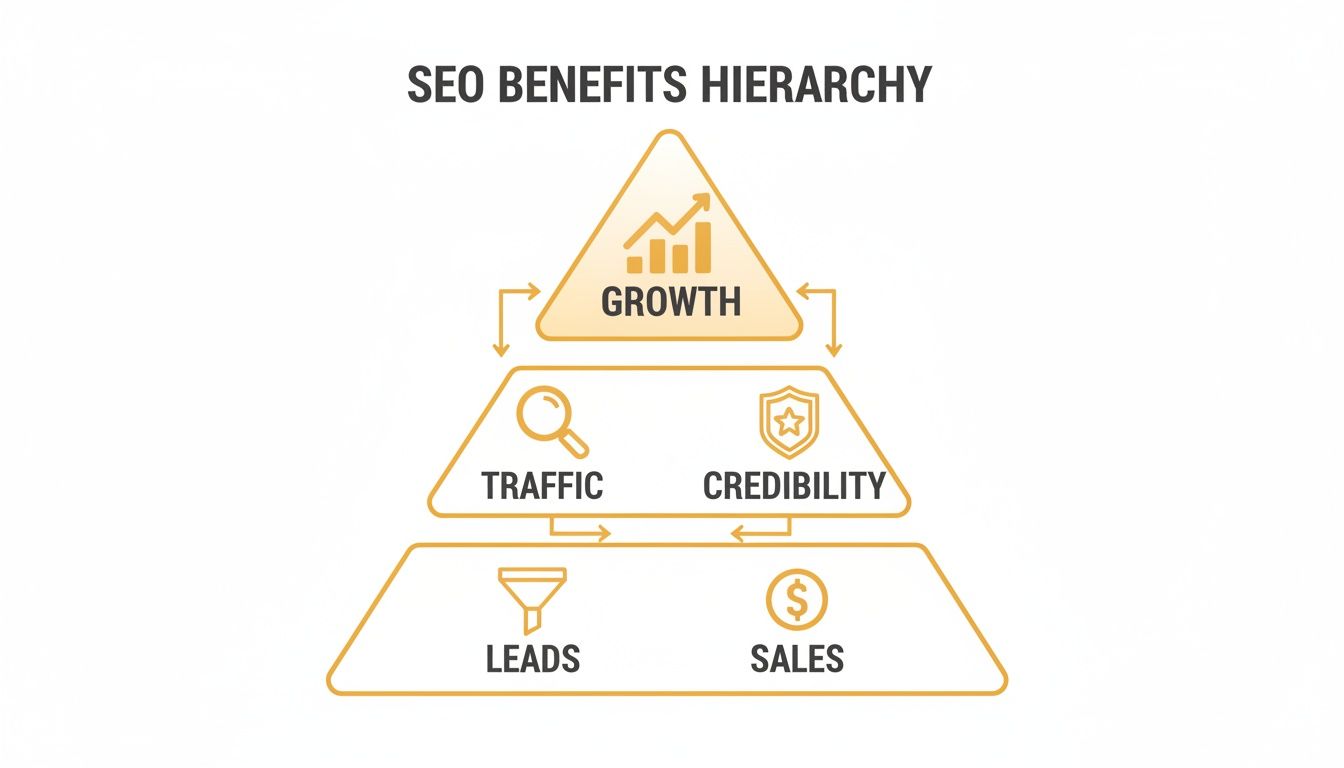
As this diagram shows, when you bring it all together, a complete SEO strategy ultimately drives qualified leads and sales, delivering measurable growth for your business.
How Kiwis Are Searching for Businesses in 2024
The way people in New Zealand find what they need online is going through a massive shake-up. If you still picture someone sitting at a desk typing a few keywords into Google, you're missing a huge piece of the puzzle. Search today is far more conversational, visual, and happening on the fly.
This isn't just a small shift; it's a fundamental change in how we interact with the internet. And it means that Search Engine Optimisation (SEO) has had to evolve, too. It’s no longer just about clawing your way up a list of blue links. It’s about being the answer, right when and where your customers are looking for one—whether that's asking their phone for directions, scrolling through Instagram, or getting an instant summary from Google's AI.
Voice Search is Now Mainstream
Think about how often you hear someone say, "Hey Google, where's the best flat white in Wellington?" or "Siri, find a plumber near me that's open now." This is the new reality. Voice search is exploding because it's easy, hands-free, and mimics how we naturally talk.
For Kiwi businesses, this is a game-changer. People don't speak in clipped keywords; they ask full, detailed questions. This means your website content needs to stop sounding like a corporate brochure and start sounding like a helpful expert. It needs to directly answer the kinds of questions your customers are actually asking, in plain, conversational language.
This isn’t some futuristic trend, either—it’s happening right now. A staggering 50% of all searches are now voice-based. That’s a clear signal that your SEO strategy needs to adapt. If you're not optimising for these natural-language questions, you're becoming invisible to half of your potential customers. You can dive deeper into these trends with the latest New Zealand digital marketing statistics.
Google Is an Answer Engine, Not Just a Search Engine
At the same time, Google itself has changed its mission. It no longer wants to just be a directory of websites; it wants to be an answer engine. The goal is to give you the information you need instantly, without you ever having to click away from the results page.
You see this every day with features like:
AI Overviews: Those AI-generated summaries that sit right at the top of the page, pulling together information to answer complex queries on the spot.
Featured Snippets: Often called "position zero," these are the handy boxes that lift a direct answer from a webpage and display it prominently.
Knowledge Panels: The info cards that pop up on the side of the screen, giving you a quick snapshot of a local business, including its hours, location, and reviews.
For your business, this changes everything. The aim is no longer just to rank #1, but to be the source for these direct answers. When you create clear, well-structured content that directly tackles your customers' most common problems, you're basically spoon-feeding Google the exact information it needs to feature you.
Your Customers Are Searching on Social Media
Here’s a crucial one, especially if you're targeting younger Kiwis: their search for a product or service often doesn't even start on Google. For many, platforms like TikTok and Instagram are the new search bars. A Gen Z Aucklander looking for "best vintage shops" is just as likely to search on TikTok to see real people showcasing their finds as they are to use Google.
This phenomenon is called social search, and it demands a completely different approach. It’s less about technical code and more about creating engaging, helpful content that shows up where your audience is already hanging out. Think video tutorials, customer reviews, or behind-the-scenes looks at your business.
To succeed today, a Kiwi business needs an SEO strategy that fires on all cylinders. You have to be ready for typed keywords, spoken questions, and visual discovery on social media. By being present and providing clear answers across all these fronts, you make sure you’re seen by your customers, no matter how they choose to look.
Measuring SEO Success with Metrics That Matter
So, you’ve put in the work on your SEO. But how do you actually know if it’s paying off? It’s far too easy to get caught up in vanity metrics, like chasing that coveted number one spot for a single keyword. Real success, however, is measured by the impact on your business's bank account.
To figure out if your investment is worthwhile, you need to track the right Key Performance Indicators (KPIs). These are the numbers that show you how SEO is fuelling actual growth, from getting the right people to your website to turning them into paying customers.
Core KPIs for Tracking SEO Performance
Instead of drowning in analytics reports, it's best to focus on a handful of metrics that tell a clear story. These are the KPIs that connect what you’re doing in SEO directly to business outcomes, giving you a transparent view of your return on investment.
Here are the ones that truly matter:
Organic Traffic: This is simply the number of people landing on your website from unpaid search results. A steady climb in organic traffic is the first, most obvious sign that your Google visibility is improving and more potential customers are finding you.
Keyword Rankings: Now, while obsessing over one keyword is a mistake, tracking a group of your most important ones is crucial. You want to keep an eye on your position for "high-intent" terms—phrases people use when they're ready to buy, like "buy merino wool socks NZ." This tells you if you're reaching people at the perfect moment.
Conversion Rate: This is the big one. It's the percentage of your website visitors who take the action you want them to, whether that’s making a purchase, filling out your contact form, or signing up for your newsletter. A healthy conversion rate means your SEO isn't just bringing in traffic; it's bringing in the right traffic.
Understanding the SEO Timeline
One of the most common pitfalls for business owners is expecting results overnight. SEO isn’t like running a paid ad where the traffic starts the moment you pay. It’s a long-term strategy for building a valuable, sustainable asset for your business. Think of it as a marathon, not a sprint.
SEO demands patience. You might see some encouraging signs within the first 3-4 months, but the truly meaningful results—like a noticeable jump in leads and sales—typically build over a 6 to 12-month period.
Why does it take so long? Because it takes time for Google to crawl, understand, and trust the changes you’ve made. It takes time for your content to build authority and for those valuable backlinks to start making a difference. If you treat SEO as a gradual, compounding investment, you’ll set realistic expectations and see its true, lasting impact on your business's growth.
Your First Practical Steps to Improve SEO

Jumping into search engine optimisation can feel like a mammoth task. The theory is one thing, but where do you actually start? The good news is you can make a real difference with a few simple, foundational actions.
These first steps are straightforward and won't cost you a cent. Better yet, they're designed to give you the best return for your time—especially if you're a local Kiwi business. Forget trying to do everything at once; focus on these high-impact tasks first.
Claim and Optimise Your Google Business Profile
Your Google Business Profile (GBP) is probably the most powerful free local SEO tool you have. It's that handy info box that pops up in Google Maps and on the right side of the search results when someone looks up your business name or a local service you offer. Leaving it unclaimed is a huge missed opportunity.
Think of it as your digital shopfront. Here’s how to get it sorted:
Claim Your Profile: Head over to Google Maps, find your business, and click "Claim this business."
Fill Out Everything: Make sure your business name, address, phone number, hours, and website are 100% accurate. Even small inconsistencies can confuse search engines and customers.
Add Good Photos: Show off your shop, your team, and your products or services. A picture really is worth a thousand words here.
Encourage Customer Reviews: Don't be shy—ask happy customers to leave a review. And make sure you reply to them all, good or bad.
A polished Google Business Profile is often the quickest way to appear in local searches for things like "cafe near me" or "electrician in Hamilton." It instantly builds trust and visibility right where it matters most.
Start with Basic Keyword Research
You can't really optimise your website if you don't know what words your customers are actually using to find you. Keyword research isn't about guessing; it's about finding the real phrases people type into Google every day.
Start by brainstorming a simple list of the services you provide. A Wellington-based accounting firm, for example, might jot down "small business tax returns," "GST filing," and "payroll services." From there, you can use free tools like Google's Keyword Planner to see how many people are searching for those terms and uncover related phrases you might have missed.
Once you have a handful of relevant keywords, you can start weaving them into your most important website pages. Deeper research is a cornerstone of a solid strategy, as you can see in our digital marketing solutions.
Make Sure Your Website Is Mobile-Friendly
It’s no secret anymore: well over half of all web traffic comes from mobile devices. If your website is a pain to use on a smartphone, visitors will simply leave, and Google will notice, pushing you down the rankings. This isn’t just a nice-to-have; it's absolutely essential.
This is even more critical when you consider how younger Kiwis search. They're not just on Google. Platforms like TikTok and Instagram are becoming their go-to search engines for everything from product reviews to finding local businesses. Your site has to work seamlessly for these mobile-first users, no matter where they find you.
Your SEO Questions Answered
So, you get what SEO is, but a few practical questions are probably still bouncing around in your head. That’s completely normal. Business owners I talk to all across New Zealand are often wondering about the real-world stuff—how much does this actually cost? When will I see a difference? And how does it fit in with my other marketing?
Let's tackle those big questions right now so you can move forward with confidence.
How Much Does SEO Cost for a Small Business in NZ?
Honestly, there’s no single price for SEO in New Zealand. The investment really depends on your industry, how fierce the competition is online, and what you’re trying to achieve. It’s much healthier to think of SEO as building a valuable long-term asset for your business, not just another monthly bill.
A local plumber or café might start with some foundational work for a few hundred dollars a month. In contrast, a nationwide e-commerce store trying to outrank major players could be looking at several thousand. The key isn't the price tag itself, but finding a partner who lays out a clear strategy designed to bring in more business than it costs.
The real question isn’t just, "How much is it?" but, "What kind of growth will this investment create?" A smart SEO strategy should more than pay for itself over time through new customers and sales.
How Long Does It Take to See SEO Results?
SEO is definitely a marathon, not a sprint. You might see some encouraging signs and a bit of upward movement in the first 3-4 months, but the kind of growth that truly moves the needle—a significant jump in organic traffic and leads—generally takes 6 to 12 months to come through.
Why the wait? Because it takes time for Google to crawl your changes, recognise the quality and authority you're building, and start trusting your site enough to show it to more people. Consistency is everything. If any agency promises you instant number-one rankings, be very cautious. Those sorts of claims usually involve risky shortcuts that can get your website penalised down the track.
What Is the Difference Between SEO and Google Ads?
Both are fantastic ways to get in front of customers on Google, but they do very different jobs. Knowing how they work together is the secret to a really effective marketing plan.
SEO (Organic Search): This is all about earning your spot in the main, unpaid search results. It builds lasting trust and credibility with both Google and your customers. The best part? It creates a sustainable stream of traffic that keeps flowing even if you pause your marketing budget.
Google Ads (Paid Search): This is where you pay to place an ad right at the top of the search results for specific keywords. It's brilliant for getting immediate traffic and visibility, but that traffic stops the second you turn off the campaign.
A solid digital strategy almost always uses a mix of both. SEO builds your long-term foundation for growth, while Google Ads are perfect for targeted, short-term pushes or testing new offers. If you’re unsure about the right mix for your business, we can help you figure it out. Just get in touch with our team and we can chat about your goals.
Built with Outrank

Comments